Showing posts with label racism. Show all posts

July 21, 2017

Automatic, Problematic


The lights whizzed by as they were consumed by the darkness around them. I was unable to make out the street signs, even from my window seat. Nate sat next to me, and Kip was next to him staring out his window. Their roommate, the birthday boy, was in the front with the cabbie. For a kid celebrating his 21th birthday, you’d think Titus would have been a little drunker on our way out, but he chatted the cabbie up like he was on his way to the office. The driver was Sri Lankan, if I remember my accents right. He seemed like a decent, honest man. I wondered how often the man drove his cab this late, gathering bizarre stories. His tall beige turban intrigued me as well.

On our way towards the bar, we almost hit a couple walking across the intersection. As he left the scene of the incident, the driver said, “I hate black people. They always walk in front of my cab when I have a green light, they can’t drive, and when they’re in my cab they’re loud and don’t tip! Not to mention, they are lazy.” He seemed to quiet down but then added, “And they always stare at my turban. Do I stare at them in their dingy durags? No. I don’t. Black people infuriate me.”

Titus looked back towards me and laughed. Obviously the cabbie didn’t see the black kid get in last and sit right behind him. “Yeah, don’t you agree, Greg?” Titus asked me. Of course what the man said could be said for some of the black people in DC, but they were still stereotypes. I didn’t fit any of those stereotypes other than the fact that I don’t tip. Reserving funds was a must.

I passionately wished to respond and challenge the small minded immigrant, but the night was young and getting kicked out of a cab was not on my list of fun activities. So I played along and said, “Yeah, I hate those damn niggers. They’re no good.” I always joked about my race, but if any of my black friends heard me say that, they’d probably excommunicate me. Not because I agreed with the racist cab driver; because I said nigger around white folk. But for me, comedy always came before political activism. Mom never did think I had my priorities straight.

My companions laughed for a bit, soon falling silent. I continued to stare at the man’s turban through the greasy plexiglass, wondering what might be under it. It was as big a mystery as what his wife looked like under her burqa – maybe bruises and scars he gave her. Why did he smell so strongly like curry when it was well after dinner time? How did he end up driving a taxi for a living? How did he end up in this country for that matter? He couldn’t have been a first-born American; he didn’t sound it.  Within seconds my forehead succumbed to a burning sensation.

“Greg, you alright?” Nate asked. “You’re scowling.” I raised my cold hand to my face, attempting to distribute some of the heat. I didn’t talk for fear of my own unpopular remarks slipping out; instead I flashed my friend a reassuring “everything’s gravy” smile. Returning my gaze to the window, I saw our destination to the left. Good. I needed to drown my frustrations.

November 12, 2015

Exposing Private Racism


As someone of the non-Caucasian persuasion, I'm very aware that racism is still alive: from the outright Confederate flags to the lowkey micro-gressions that happen every day. However, as a person of color, you can't stumble through life assuming every white person harbors ill will against you. Occasionally a few will slip up on Facebook or Twitter, but people are clever enough to wear metaphorical hoods these days.

I originally that about this while watching Aziz Ansari's new Netflix original Master of None over the weekend. It's a little rough around the edges, but overall it's a great show with outstanding content with topics ranging from dating to a woman's everyday struggles. In the episode* "Indians on TV," Aziz' character Dev doesn't want to portray Indian stereotypes for acting roles. Soon he gets a shot for a buddy sitcom, but the network execs exchange emails expressing how they don't think the show can succeed with two Indian actors and want to see which one can "curry their favor." The email chain is mistakenly sent to Dev, who then confronts the exec who wrote the "curry" line only to be treated out to a wonderful night out in the hopes that Dev will keep quiet. His conscious eventually catches up to him and he leaks the email that results in the exec's termination from the studio.

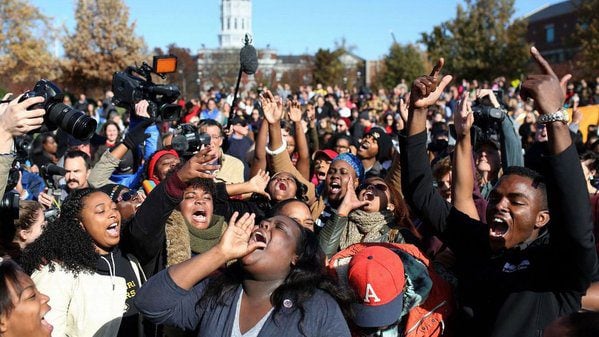
So I found much humor this past Monday when Tim Wolfe, [former] president of the University of Missouri, resigned after student protests spurred by his indifference toward racial tensions and threats. However just two days later, the campus faced death threats against its black students. I also read today that students at Howard University in DC are facing the same threats. It would seem that the resignation did the opposite of healing, but instead inspired radical racists to expose themselves.

So, what can we do? Well, for one, everyone on any college or work campus facing such threats, stay safe. But we have to keep this racial discourse going. We cannot stop talking about racism and other issues facing our society. Silence just allows the hatred to lie in waiting, quietly poisoning our society. As dangerous as it may become, we have to remain vocal in hopes that we'll educate the masses and expose racist behavior until its eradicated. Keep the protest going, my dear friends and associates. May we all truly be equal some day.

Word.


*Anytime someone starts a sentence with "In the episode,"  you should be fully aware of the spoilers ahead. However, I do apologize if you've feel I've ruined the episode for you. Watch it for the jokes anyway.

**This post was originally intended for Wednesday, but after hearing the story develop, I needed time to process the information. Thank you for bearing with me.

September 2, 2014

Morality Role Call

There's a lot of malarkey and tomfoolery afoot this week,
so I'm going attempt to address as much of it as possible
without out rambling, ranting, or turning this into a "thinkpiece."

In the past few weeks,
I've noticed majority holders (whites/straights/men)
look at for the "How" in problems.
How did the officer get away with shooting an unarmed man?
How did those nudes get leaked?
How did she get raped?

I'm not sure if it's true for all minorities,
but I prefer to look for the "Why."
Why did the officer shoot an unarmed black man?
Why did someone leak this celebrities nudes?
Why did she get raped?
I'm a firm believer that asking why attacks problems at their root.
If we understand why things are happening,
we can recognize these problems before they even occur
and address them properly like the civilized society we claim to be.

For instance, while it is important to reprimand the police force
for abuse of power and find ways to stop them from doing so again,
why do they feel they can abuse their power?
Why do they feel it's appropriate to target people of color?
Why do they think they can get away with murder
with no proof of justification?
Why must black children be told to not draw attention to themselves
and not give the police a reason to stop them
instead of being able to trust those placed there to "protect" them?
These are but a few of the root questions that need to be addressed
in not only the Michael Brown case, but every case
that has featured the unjust killing or arrest of a person of color.
Because this shit happens too frequently
in all parts of this country for this to be coincidence.

Recently, a few celebrities' nude photographs were leaked,
the most notable celebrity being Jennifer Lawrence.
For some reason, people began throwing shame at JLaw.
(Or, if you're a simplistic man, you just locked yourself away for an hour.)
But why? Why do people care that much?
Ms. Lawrence took those pictures in privacy,
for her pleasure and whomever they were taken for.
She didn't leak her own pictures.
She and many others were hacked. [Damn iCloud.]
Shame the hackers. Shame those that seek to exploit her.
Shame those that share the pictures without her permission.
Slut shaming needs to stop.
A person has a right to do with their body as they please.
If you're going to call them anything,
call them promiscuous or comfortable in their own skin.

Along the same lines,
rape is not funny.
It is also not the victim's fault.
Why are women told not to dress so "provocatively?"
Why are men not instructed to behave themselves,
take no for an answer, and not rape anyone?
The old way only suggests: "Don't be the one rape; let it happen to that other girl."
And why are male rape victims told to man-up and keep quiet?
That's a whole different issue about masculinity that I don't have steam for.

It's very obvious that I don't have all of the answers.
But I am willing to ask all of the questions
in the hopes of building a better society and making people think.
America likes to think ourselves better than other countries,
but a few of those "bad guys" just scolded us
for the inhuman treatment of the folks in Ferguson.

Listen, I know you want to think the United States only has a few problems,
but it has many. Some problems you might not even grasp fully.
But if you choose to ignore those problems
instead of learning about them, you're part of the problem.
I repeat, you're part of the problem.
Be a better person than our parents and grandparents.
Stand up for others' rights and protection in this country.
It's the moral thing to do.
Word.

March 24, 2012

Story Time: Cab Relations

The lights whizzed by as they were consumed by the darkness around them. I was unable to make out the street signs, even from my window seat. Nate sat next to me, and Kip was next to him staring out his window. Their roommate, the birthday boy, was in the front with the cabbie. For a kid celebrating his 20th birthday, you’d think Titus would be a little drunker on our way out, but he chatted the cabbie up like he was on his way to the office. The driver was Indian, if I remember my accents right. He seemed like a decent, honest man. I wondered how often the man drove his cab this late, gathering bizarre stories. His tall beige turban intrigued me as well.
On our way towards the bar, we almost hit a couple walking across the intersection. As he left the scene of the incident the driver said, “I hate black people. They always walk in front of my cab when I have a green light, they can’t drive, and when they’re in my cab, they’re loud and don’t tip! Not to mention, they are lazy.” He seemed to quiet down but then added, “And they always stare at my turban. Do I stare at them in their dingy doo-rags? No. I don’t. Black people infuriate me.”
            Titus looked back towards me and laughed. Obviously the cabbie didn’t see the black kid get in last and sit right behind him. “Yeah, don’t you agree, Greg?” Titus asked me. Of course what the man said could be said for some of the black people in DC, but they were still stereotypes. I didn’t fit any of those stereotypes other than the fact that I don’t tip. Reserving funds was a must.
            I passionately wished to respond and challenge the small minded immigrant, but the night was young and getting kicked out of a cab was not on my list of fun activities. So I played along and said, “Yeah, I hate those damn niggers. They’re no good.” I always joke about my race, but if any of my black friends heard me say that, they’d probably excommunicate me. Not because I agreed with the racist cab driver; because I said nigger around white folk. But for me, comedy always came before political activism. Mom never did think I had my priorities straight.
            My companions laughed for a bit, soon falling silent. I continued to stare at the man’s turban through the greasy plexiglass, wondering what might be under it. It was as big a mystery as what his wife looked like under her burqa – maybe bruises and scars he gave her. Why did he smell so strongly like curry when it was well after dinner time? How did he end up driving a taxi for a living? How did he end up in this country for that matter? He couldn’t have been a first-born American; he didn’t sound it.  Within seconds my forehead succumbed to a burning sensation.
            “Greg, you alright?” Nate asked. “You’re scowling.” I raised my cold hand to my face, attempting to distribute some of the heat. I didn’t talk for fear of my own unpopular remarks slipping out; instead I flashed my friend a reassuring “everything’s gravy” smile. Returning my gaze to the window, I saw our destination to the left. Good. I needed to drown my frustrations.

March 22, 2012

On Looking Suspicious

There just seems to be all kinds of f**kery occurring in March.
By now, we've all heard about the death of Trayvon Martin
and the possibly most likely racist self appointed head of the neighborhood watch who shot him.
Here's an article if you haven't.

Through the years, there have been far too many instances of a black person, more specifically a black male, looking suspicious enough to justify a beating or murder with a very slow legal process following, if any at all.
It's enough to terrify a young black man.
Certainly enough to scare me.

As usual, I avoided looking into the situation
because I knew it would only infuriate me and I like having pleasant days.
But these sort of things always find their way to me.
Today in my writing seminar,
we talked about the massacre of 16 Afghans -
which is another very important issue and discussion.
Of course, a relation was made to Trayvon and we talked about it.
Midway through the conversation, the topics racial profiling and suspicion arose.

I avoided adding my two cents in the conversation,
being the only kid of color in the room,
forcing me to have an internal dialogue.
I realized what I was wearing: a red and black plaid lightweight hoodie,
black shorts, red Chuck Taylors, and an ironically outdated red fitted cap I found.
I realized where I was: a extremely white campus where topics of race and discrimination are avoided by the majority.
I realized the person I was molding myself into: a self-proclaimed black hipster who knew how to interact with Caucasians and educated black folk, while gained the trust and respect of said individuals.
It was at this moment I became aware of what I was doing: becoming as far from "suspicious" as possible.

It's hard to pinpoint if I actively set out
to accomplish this as a high school graduate
and consciously forgot my mission along the way,
but I wouldn't put it pass myself.

Still to the best of my abilities,
I can't escape the feelings that I don't belong.
Whenever I walk through a predominantly white neighborhood,
I still feel the need to tread lightly.
I utterly refuse to run through such neighborhood.
Actually, I wouldn't run pass a cop car either.
No need to give them any reason to berate me.

In light of the 9/11 attacks,
you would think white would target middle easterners instead.
In fact, I remember jokes around black neighborhoods
wishing such would actually happen.
The reality of the situation is that
the terrorists are not on our soil but overseas.
Whereas African-American hoodlums are a prominent issue here.

Am I saying stereotyping as such is acceptable? No.
Do I propose anything to fix this issue? Yes,
but such a theory deserves sharing with other and feedback before becoming public.
What I will say is this.
To this day in the 21st century,
I am still cautious about being a black man in America.
I do not deserve such a terror to haunt me.
Yet I fear it may loom forever over us.
Word.

March 19, 2012

Story Time: They Called Me Nigger

I remember looking out the window of my mom’s car on the way to school at miles of trees and farm land. The South was so different from New York City. I wouldn’t find a crowded subway anywhere near here. After twenty minutes, we arrived at St. James Prep, a private all-male Catholic school. My mom always preferred private schools to public: better education and morals, she said. I left the car without saying goodbye, my mind too focused on the day before me.
            The brick porch leading to the entrance was bare; we must have misjudged the starting time. Late for my first day of high school, what a way to start the school year, I thought. Entering the building, I searched my pockets for my class schedule. I walked through the empty halls until I found my homeroom, cracking open the door and poking my head in.
            “Ah, you must be Mr. Williams,” the teacher motioned towards me. “Please, have a seat.”
            As I took my seat in the front, the only spot left, I looked at my fellow classmates. There were only three other kids the same color as me. My middle school had been much more diverse. I wondered if this was how the population of the entire school broke down. I snapped out of my thoughts as the teacher introduced herself and told us that high school would be much harder than middle school.  We were let out at the bell’s ring. I didn’t bother looking for my locker just yet since I had nothing to put in it. Besides, I felt stares from other students while walking in the hall. Was it that obvious that I was a city boy?
            The same was true for my following three classes. In Algebra, there were two the same race as me; in U.S. History, there were four of us; in English, I was on my own. It wasn’t until lunch that I saw more than ten of us at a time. My people were all sitting together at a table in the corner. I was tempted to join them, but I refused to segregate myself. As I expected, the other tables were completely made up of the majority. I tried to put my anxiety aside as I walked over to a table in the middle of the cafeteria.
            “Hi,” I said as I placed my tray down. “My name is Taylor.”
            I was greeted warmly by a boy directly across from me. “Nigga, why don’t you just sit with da rest of da crackas in da corner? You know you want to.”
            I froze upon hearing “the word.” I had never heard it much at my old school. Maybe once or twice while walking around the city but never in school. I couldn’t believe he had called me one. I thought that was something black people reserved for themselves. “You’re talking to me?” I asked.
            “Yeah you, nigga. You see anyone else without pigment in their skin at dis table?”
            “N-no.”
            “Then get ya ass to da table in da corner, then!”
            I walked in shame to the table in the corner. I wasn’t aware that integration was a crime in the South. I took my place at the White table in silence.
            “Don’t let him get to you. I hear it’s like this with every freshman class. They’ll warm up to us as the school year goes on,” a red-haired kid explained. “My name is Rufus, but you can just call me Ruff.”
            “…Are you trying to make your name sound less white?”
            “If you want to put it so bluntly, yes. I’m attempting not to get picked on for my name. Do you know how corny and white Rufus sounds?”
            “I’m Lenny,” the kid next to me interjected. “You know, I heard that once we get to be seniors, we’ll gain enough respect from the black kids to actually start using the word ourselves.”
            “You must have heard a lie,” I told him. “No self-respecting black person would let you call him the N-Word.”
            “No, it’s true.” Ruff agreed. “My older brother graduated from here last year. He said it starts with us making fun of the black stereotypes anytime they joke about a white stereotype. Then we begin to call ourselves the word, first while no blacks are around so we can get use to hearing and saying it without cringing. Finally, our senior year, one of us has to be brave enough to try it out on one of them. Someone in the middle, no one too popular or unpopular. Once that’s done, we can come together as a whole class and use the word as a term of endearment.”
            “Oh, so the kid at the table called me the word as a term of endearment?”
            “No, he was disrespecting you,” Lenny clarified. “Blacks use it both ways. We can only use it in its positive sense.”
            “Right, using it negatively like they do will only end in a fight,” added Ruff.
            “God, I thought remembering math equations would be hard.”
            “Well, it’s kinda like math,” Lenny said. “The things you learn one day will be implemented for the entirety of your stay here at St. James. “
            “Oh, that reminds me,” Ruff leaned in close and stared right into my eyes. “Don’t use big words around some of them. They’ll think you’re trying to embarrass them.”
           
            I sat down at the table and peered directly into the eyes of the kid who told me to leave the table prior. “What do you want now?”
            “I want to be accepted for who I am, not the color of my skin” I paused for dramatic effect, realizing how lame and cliché I must have sounded. Then I finished, “nigger.” They called me the word, so why couldn’t I call them the same?  However, it took every fiber in my body to keep me from running out of the cafeteria.
            I should have ran, because just as the word left my mouth, the two kids sitting next to me grabbed my arms as the other lunged across the table. I don’t think I had ever been beaten so badly in my life. It was two minutes before anyone tried to break it up. The black teacher supervising the lunch wanted me to learn my lesson. I thought about telling the principal about his lack of intervention, but I didn’t want to get in bad with the faculty too.
            Apparently, I had stopped listening to Ruff and Lenny just as they were explaining the difference between the –a and –er forms of the word. It made a world of a difference, I realized now. Damn my proper grammar. As I laid in the nurse’s room, waiting for my mother to come in, ice on my right eye, I doubted that even if I had used the –a version of the word I would have broke down the racial barrier in the school. I would have to approach the issue with more subtlety next time. Maybe I could joke how the black kids had made me black and blue, that I was one of them now. I think I’ll wait until this whole mess blows over though. Enough insult and injury had been exchanged to last the week.