Showing posts with label black issues. Show all posts

November 2, 2020

Bleacher Report (2/31)


        Courtney sat bored with his elbows on his knees, chin in palms. It was a bad posture technique he learned at his last high school in New Jersey sitting in the three-row bleachers during morning prayer. Though he didn’t care for the Proverbs and bible stories he had heard since he was in kindergarten, occasionally things would liven up when the director of music would play seemingly improv-ed call and response songs on a wooden piano that never received the tuning it deserved. It was fun; it was full of comradery, yet he never felt like that showed school spirit. Now, roughly 1400 miles away in Kansas, he pined for the days when he didn’t have to listen to cheerleaders fumble over cheers they wrote themselves.


        Having always been a nerd - but never a dork - Courtney considered himself smarter than the people around him despite his steady A-/B+ at best average. His last school, while being highly dominated by country-renowned HS soccer players and NBA draft hopefuls, never forced sports into any student’s blood stream. Rather they highly encouraged - read: threatened - each young man to join an after school activity. So, Courtney found himself writing and editing the literary magazine only the teachers read, acting in the plays only the parents came to see, and singing in the chorus only judges (and the school during special assemblies) had the privilege to hear. Now he was lucky to enroll in an art class with barely any supplies as an elective.


        He looked at the gymnasium scoreboard to see how much time had gone by. “3:27,” it read. Either it was frozen from a previous game or he really still had over a half hour to go. He stood up in an attempt to fake going to the bathroom. “Sit down, new kid.” Courtney couldn’t remember his name, but it definitely came from the JV football running back or tight end desperately waiting for his turn on Varsity he met in homeroom earlier that day. Sitting next to JV was Mr Anderson who pointed Courtney back to his seat. Like everyone else, they wore the school’s colors while he kept a low profile in all black. Suddenly feeling shackled to the top of the sixteen-row bleachers, he sat down wishing he was tall enough to defy the pair by climbing through the window a foot over his head.


        Meanwhile on the gym floor, the cheerleaders had formed a human pyramid. He checked to see if any guys were at the base, but the only two seemed like straight reject-jocks. The lack of diversity drove him further from buying into this midwestern excuse for passing time. Like a teen-drama wiccan, Courtney tried to use his mind to force the apex cheergal to take a tumble. When she slipped, he let out an audible gasp, but it was choreographed. She fell neatly into one of the beefy cheerguy’s arms, spun out of his grasp and threw her arms in the air. He wanted to hate her for sticking the landing but this was the closest he would get to theatrics at this school, so he supplied the applause with my more fuel.


        “Yaaaaaas, Mine Creek High!” Becca screamed to the stands causing Courtney to gag over the blind appropriation. “Keep that energy going for your team captain - and my boyfriend - Luke Price and the Mine Creek Ringnecks!” Becca and the other cheerleaders quickly cleared the court floor as the lights deemed. Courtney looked above him and the blinds to the window were suddenly drawn close. He could barely see the row of blonde students seated in front of him.


        Strobe lights began to flash over the basketball court. A student in the front row immediately had a reaction, but he was rushed out on a stretcher almost as soon as he fell out like this happened every time. Courtney looked back to the center of the court, but the circle was missing. Then, a hitler-youth haircut rose from the floor followed by the body of a 6’4” adonis, his white and gold helmet under his arm as he rotated on a platform until it locked into place, level with the rest of the floor. He placed his helmet before his New Balance’d feet and dared the student body to make more noise by pumping his left arm in the air. “Ring!” “Necks!” “Ring! “Necks!” Courtney felt his color and popped his collar to protect his neck before anyone got any ideas. Almost as if waiting for his cue, the floor to the right and left of Luke began to flip over. On the other side, the rest of the Ringnecks were strapped down in their starting positions. The crowd went wild! The strobe lights sped up. Courtney looked around for a Sue Sylvester-type to see if this is how the budget for the arts was squandered.


        The remainder of the pep rally wasn’t nearly as eventful. It was an odd ten minutes of each member of the starting line up throwing words together to express how easily they were gonna beat last year’s 7-6 record. The 18-0 soccer team at Courtney’s old school would never have gotten this much attention, but at Mine Creek these mediocre Ringnecks were gods. The confusion and despise for school spirit hit new highs for Courtney once he was finally released from the gymnasium.


        In the parking lot, seniors and juniors sped off in Jeeps while sophomores and freshmen were picked up in their parents’ SUVs, yet they all shared similar bumper stickers: “Mine Creek Athlete on Board, Make Way,” “Make America Great Again!,” “American Pride or Die!” It was all an odd spectacle as Courtney climbed on his bike. Before he could pedal the five miles home, he heard leaves being crunched behind him and turned around to spot a girl with braces begging for his attention.


         “Hey, you almost forgot your team schedule!” the girl waved the Ringnecks Home-Away schedule in front of his face.


         He put his helmet on and strapped it tight. “Yeah… I’m good.” He rode off onto the non-lit road, hoping he’d make it home before sundown at 4:37.

Word

~~

If you like what you read, please consider tipping the author.

venmo.com/cgwacko
cash.app/$cgwacko

February 1, 2016

Black Erasure


First things first, happy Stay Woke Awareness Month, or as it's more commonly known Black History Month. Sorry I took a week or so off, had to recuperate and refocus. See, I've noticed the amount of softballs and fluff pieces I've been producing. In an attempt to give you all better content, I'm here to present to you a theory that's so apparent it's hard to believe: white America is trying to wipe black America out of existence.

Now, I don't mean every single white person. No, don't be silly. This is directed at the powers that be - the Man or Council of Supremacy, if you will. You have to understand, they're just trying to hold on to the past. They arranged things just the way they liked it, and they intend on keeping it that way. Why give up your seat upon the throne to share a slice of cake when you can eat it?*

How are George Washington's Wooden Dentures taking us out one by one? Allow me to lay these conspiracies upon you, my dear brothers and sisters [and cousins].

The most tragic and apparent injustice against people of black descent are the countless instances of police brutality and fatality. One would have thought the lesson would have been learned from the Rodney King case, but history does tend to repeat itself. Luckily, social media exposes more corrupt and malicious police officers than ever before. Unfortunately, the incrimination rate of these officers is not as high. It is constant insult to injury for nearly every instance. In the grand scheme of things, this makes sense. Why would the White Shadow wish mass genocide upon us like the KKK? We were more useful to them as broken people. They wish to tire us mentally.

They start out small, almost microgressions. For the past 50 or more years, the American sports industry has been dominated by black players - an amazing result of slave breeding that's worked in our favor. However, in the NFL, the majority of quarterbacks are white - because, you know, leaders are white. Russell Wilson is the only black quarterback to have appeared in the Super Bowl as of Super Bowl 49 [or XLVIII]. During the 2015 season, we have been graced by the magnificence that is Cam Newton, but he's been faced with adversity as people call him a thug or worse. Apparently dabbing in the end zone is a terrible offense. They find anyway to disgrace a black quarterback, but will defend a white quarterback until they're backed into a corner. Sure, some cases have been dismissed at accusations, but in most environments being accused of rape should destroy your career.

Sports aren't the only public arena black people are discredited. By now, we've all become familiar with the phenomenon that is #OscarsSoWhite. The clear disrespect that Sylvester Stallone is nominated while Michael B Jordan and Ryan Coogler remain neglected for their work as lead actor and director, respectively, is ridiculous. In fairness, I haven't seen the movie. It's just amusing that the prominent white actor in what could very easily be considered a "black movie" is the one being recognized for his talents. But you know, when you're an old white men sitting on an academy award committee you truly want to see yourself represented in the media because you've never had the opportunity before.

I'd like to wrap up my first militant post of 2016 with a nod to Michael Joseph Jackson. You've faced plenty of adversity in your life: abuse from your father, vitiligo, the Pepsi incident, child abuse/rape claims, monkey ownership, etc. However, you were a wonderful and impactful black man. Very proud of it, if memory serves correctly. So allow me to formally apologize for the casting of Joseph Fiennes in a fanfic about you, Elizabeth Taylor, and Marlon Brando fleeing a post 9/11 New York City - for both the white actor portraying you and what's sure to be a clusterfuck of a film. Also, I'm sorry for the whiteface Flex Alexander donned in that one television movie. Maybe we should just leave you out of films.

The problem of whitewashing characters is all too real. I'm glad no one has tried to hide behind the thin vail of colorblind casting only to be asked why the cast looks like a box of Rice Krispies. Shout out to the colorblind casting of Hamilton and their sold out run into the Fall.

There are more examples I could mention, but we have a whole month of awareness to get through. I sincerely wish the best for all of you. Don't allow the media to tell you your worth or lack thereof. Black, white, and every other ethnicity, we are all amazing. There's room for us all; don't allow the human manifestations of Scrooge McDuck and Foghorn Leghorn to erase you out of existence.

Word


*I don't know how idioms work, you guys. Help!

September 23, 2014

Black White Kids and White Black Kids

"New blacks" and select white people
have been under fire lately,
mostly for saying they live in a post-racial America
or that race isn't the problem.
As tweeter/blogger Crissle has said,
"Words mean things."
I understand what they might be trying to say,
but they're stating it in a completely false way.
Culturally, we may be heading towards a post-racial society,
but we are far from achieving it.

What I do believe is that the mixing of cultures
has affected today's youth in such a way
that they no longer sees divides among each other.
They feel free to be themselves, try new things, explore.
That's how you get black kids into goth or punk,
but they're not "real black."
That's how you get white kids trying to twerk and rap,
but they're "appropriating black culture."
[Do I think appropriating black culture is a thing? Yes.
Do I think most white people do it consciously? No.
Are managers and producers profiting off it? Absolutely.]

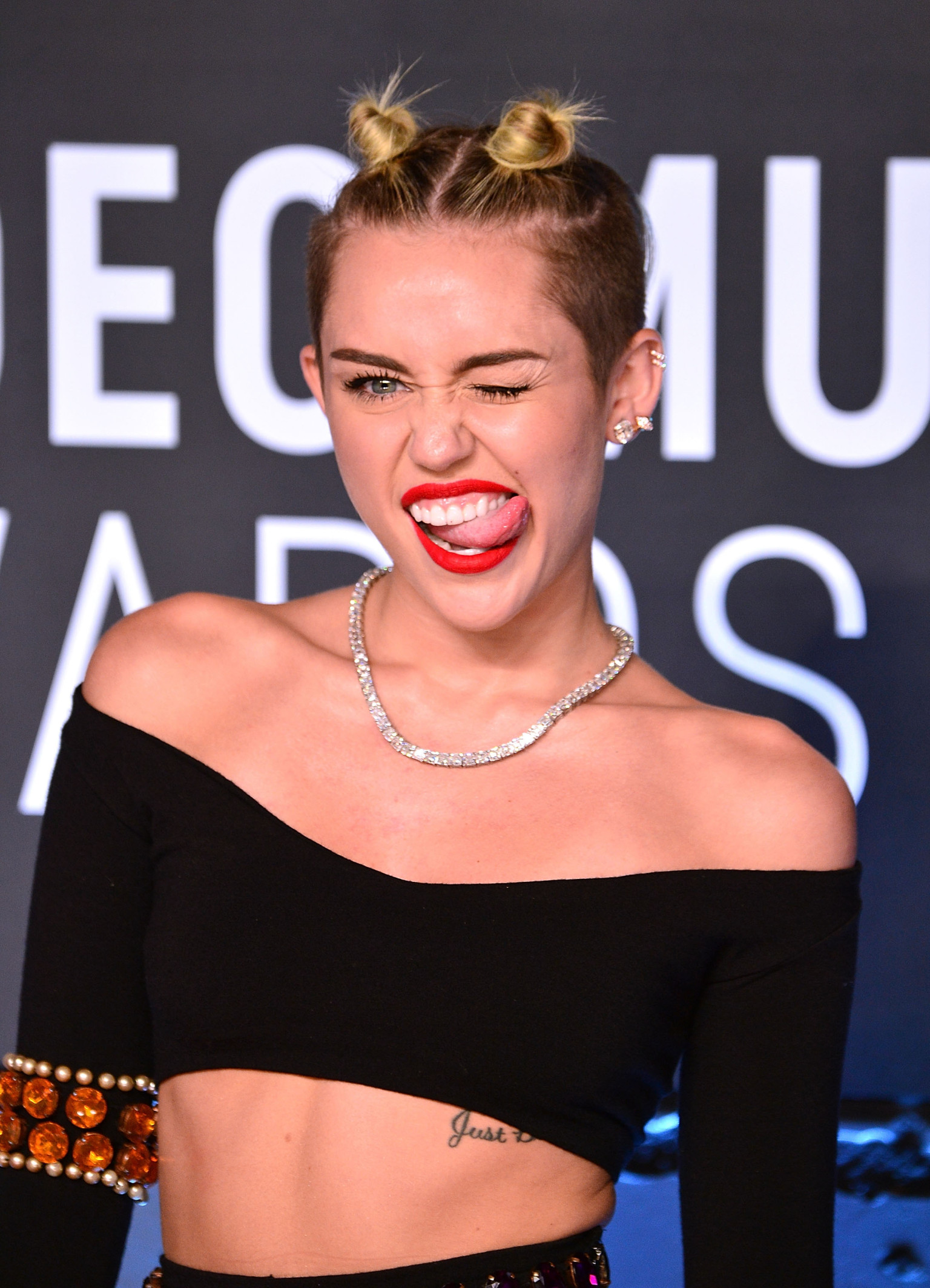
What I'm saying is I don't hate Miley Cyrus
for wanting to twerk with a big ass.
I don't think Macklemore and Iggy Azeala are the worst;
they're fans that think they're the only good rappers are.

For as long as I can remember,
black and white culture have been affecting me.
White people are always on TV and the radio,
so that's how they get to black kids.
But for a solid five years or so in the 2000s,
black recording artist ruled top of the Billboard charts.
At least 60% of the songs heard in clubs now
are either by black singers, rappers, or producers.
So it's no surprise that eventually white people
will like it and emulate it.

While we have Mac Miller in one corner,
we have Odd Future in the other.
We have FKA Twigs and the Weeknd
making music that is so different and Alternative,
but people often label them as R&B or "Alter-R&B."
Why do black singers always have to be R&B or Pop?
Look at Macy Gray.
If she isn't Alternative, I don't know what is.

It is clear to me that in 2014,
we have a melting pot of identities,
and my generation and younger
have not felt shy about switching it up.
Shit, a bunch of black teenagers in a metal band
were just signed to Sony and have a documentary in the works.

I know I've used music as sole reference in this post,
but to me, music is culture.
It's the most frequent influence in our lives.

We are a generation of just "trying to be ourselves."
Drake is a product of his environment.
Jaden Smith is a product of his environment.
Robin Thicke is a product if his environment.
(You know he had black nannies playing soul music;
that's how he ended up sounded like that.)

But as we become more integrated with each other,
it's important to remember we still have a long way to go
until we are all actually equals.
There are still old people, middle age people
stuck thinking in a way of oppression
that have taught their children to do the same.
That's why race is still an issue.
That's why he have to remind each other of what we are.
That's why we can't be blissfully ignorant.
Pretending to not see the problem is not dealing with the problem.
And that's why "Black-ish" is a terrible show.

I'm joking. I still haven't seen it.
[I will say I liked it better when it was called "My Wife and Kids."]
But a show like that will either help show how kids today are progressing,
or it'll be a mockery and sweep all of
Black America's real problems under the rug.

All this to say, let people be who they are
as long as they aren't hurting anyone or being offensive.
Be respectful to one another and help each other prosper.
You know, judge each other not "by the color of their skin,
but by the content of their character."
Word.

October 28, 2013

BlackFacers

In the past week,
there seems to be a sharp spike of fuckery in the world.
And yes, I do mean fuckery.

It started last week.
A white woman in Australia celebrated her 21st birthday.
Innocent enough until you hear it was African themed.
Yes, it was as bad as you might imagine. Worst, actually.
These Australians dressed in daishikis; they wore black face;
they wore warrior paint and painted their bodies black;
some even wore Native American headdresses.

Now, I've never been to Australia,
but are they really that culturally unaware?
The headdresses were the kicker for me.
No. I lied. It was the klansman. What even? Why? Why?!

Dear Australians and all other
non-dark skinned people around the globe,
you can attend an African themed event
without a smear of black paint across your cheek.
For goodness sake, some of you wore war paint and black paint on your skin.
That's not necessary!
Any and everyone would have gotten your costume without black face/skin.
There are even villages of white people in Africa. Did anyone dress up as a missionary or social worker at this party?
Expand your minds, evaluate your choices, and learn to be racially sensitive.
As you see, just because no one was there to be mad in the moment
doesn't mean there won't be a backlash waiting in the wings.


But no, oh no. That's not all.
The shenanigans continued that weekend
as folks got into the Halloween spirit.
The usual suspects were easy to find:
vampires, werewolves, wrecking balls running away from Miley Cyrus.
But a few decided to up their ghosts and spooks game up.
A pair of white guys thought up the perfect Halloween costume:
George Zimmerman and Trayvon Martin.
The guy dressed as Trayvon Martin would of course have to dress in black face and have a bloody gunshot hole in his hoodie.
You could add Skittles and an Arizona Iced Tea, but only if you were willing to go the extra mile.
And though the Trayvon pictured here doesn't have those items, other white men who picked the same costume did.

I'm unsure as to why this seemed like a good idea,
but let me just make it clear for you as your adoptive black friend,
it's not.

Black face aside, you are making light of a tragedy.
A very recent tragedy, one with so much racial tension behind it.
Rule of thumb, don't go as a murdered person.
The only funny or clever murder costumes involve zombies.
...oh gawd, if I see a Zombie Trayvon Martin, white or black, I'll lose it.
And not in a good way.

Let's think about it.
Dressing up as a dead Trayvon Martin is virtually
the same as someone walking around with a burnt yamaka
and calling themselves a Holocaust survivor.
It's not funny. It's not cool. It's offensive.

On the same note, I'm not a big fan of Anne Frank costumes, either.
Maybe let's chill out with that as well.


I have to admit, however, those two events are not the cause of this post.
No, I came across a photo on Twitter today that was just plain wrong.
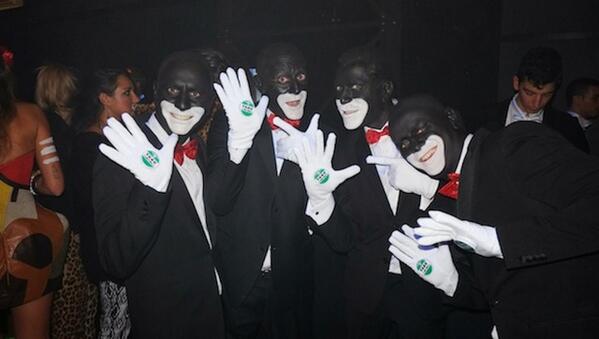
Four white men came together to form a Jim Crow quartet.
Looking at the photo again forced my left palm to my forehead, and now I must type the remainder of this blog with one hand.

But seriously, what is this malarkey?

I thought it was agreed blatant racism was over.
Black face aside again, Jim Crow was a minstrel.
It was a big slap in black America's face.
Racist to its core with no way around it.
So why would you ever dress up as a damn minstrel
if you aren't performing a rendition of Spike Lee's Bamboozled?
"Oh, my great grandpappy was a minstrel, so I'm paying homage to him."
Oh, so you come from a line of ignorant bigots.
Thanks for that insight into your back story.
[That's not what any of them said, but I can just hear it.]


Now, I'm no stranger to face paint on Halloween.
I myself have donned white face in order to portray
Dave Chappelle's news anchor character Chuck Taylor.
But there were no racial undertones or history behind it.
I just wanted to be radical and throw off white people one year.
While I was out dressed like that,
I saw a white guy in a Rastafarian get up
with black or brown face on.
I really wish I had said something, anything,
but I didn't think I had the leverage.
A young fool, I was.

I attended a party this weekend,
not even a Halloween party,
but I wore my "I'm happy to be here" mask anyway.
It turned out to be a bunch of white kids from my college
that I haven't seen in years.
And almost instantly I was "that black guy" again.
A guy or two were so friendly towards me, it was annoying.
They complimented my clothing, said I was cool,
how they could never pull off what I wore or did.
Then a white friend told me, "All white people wish they were black."
I scoffed at his lame joke, but I'm starting to wonder
what if it's not a joke.

White people in the media have been under fire lately
for appropriating black culture and making a mockery of it.
But what if they're sincere?
What if they admire us so much they want to be us,
so much so they don't realize how ridiculous or racist they're being?
Does it excuse their behavior? No, I don't believe so.
It's been said that white people love black culture, not black people.
However, there should be fewer pitchforks and torches
and more open conversations, no matter how frustrating they can be.
Some white people will never learn if we don't talk to them,
my fellow Americans (Australians, etc.) of color.
Otherwise, we'll just continue to suffer
throbbing forehead veins until the end of time.


Word


July 15, 2013

On Trial for a Murder He Died In


This past Saturday around 9 or 10pm
I watched Twitter closely
as I spotted the first tweet announcing
the jury in the Zimmerman trial had reached a verdict.
At the moment, I was playing a card game with my friend,
but I knew this moment in history was worth multitasking.

Minutes later the verdict was announced:
Zimmerman found innocent on all charges.
Acquitted.
I felt sick.
I understood from the proceedings of the trial
Zimmerman would not catch every charge thrown his way,
but not a single one?

My immediate rage was directed at the jury,
six white women who did not convict this man.
Then I realized what proof they had to go off of,
and aimed my disbelief towards the prosecution.
Could they not gather the necessary evidence
to send Zimmerman to prison?
Did such evidence ever exist?
What more could have been done?

All cylinders fired as I finally turned
to Zimmerman and his attorney Don West.
They smirked and laughed in the wake of their victory.
A tweeter mentioned, "You'd smile too if you just beat a murder case."
Albeit true, it doesn't make it any less disgusting.

Many people across various social media outlets
have mentioned that this is not a racial situation,
but that it is a failing of the justice system and process.

Believe or not, I spotted one person of color
not necessarily defending Zimmerman
but presenting his case in a light I found interesting,
and in fact almost fell for.
The gist of his argument goes as follows:
  • We only know Zimmerman's side of the story, not Trayvon's.
  • There was still cause for reasonable doubt for the jury (as far as motives are concerned).
  • When faced with a situation involving a suspect perceived as dangerous at night and alone, most of us would have acted first before even allowing ourselves to be placed in danger. Strike first or lie flat, I suppose.
In the heat of my anger,
I allowed his points to cool me down.
It wasn't until the next morning
I began to debunk them.

  • Rachel Jeantel, a witness in the trial, portrays Trayvon's side of the story, though secondhand.
  • Zimmerman was told not to pursue. The purpose of a neighborhood watch program is to WATCH, not to take action. Zimmerman should have stood by and continued to watch Trayvon at the very most. Pursuing a possible suspect puts yourself in danger, a danger which Zimmerman obviously felt equipped for.
  • With that in mind, Zimmerman pursued Trayvon ready for a violent confrontation before Trayvon displayed any violent tendencies. Zimmerman was prepared to strike first because he already viewed the kid he was following as a no-good hoodlum. 
As a whole, the verdict leaves me feeling unsafe.
While the trial was not a matter of color,
the crime without a doubt is.
Zimmerman, a large-enough white* man,
looked down on Trayvon, a black seventeen year old,
as suspicious for walking around a gated community with a hoodie on.
To me, it screams racial profiling.
Apparently there had been break-ins around the gated community,
but who's to say it was all by one criminal?
Who's to say the race of these home invaders?
Did Zimmerman have a description to go off of, to look out for?

The most vile part of the trial and media's take on the situation
is the criminalization of Trayvon Martin.
Pictures of him throwing up the middle finger and sporting gold grills are shown.
I'm almost positive those pictures were flown around last year
and it ended up being another kid who looked like Trayvon in the pictures,
but I may have my facts wrong on that one.
They attempted to bring up old charges such a theft on school grounds
- which were dropped - and suspensions he racked up in high school.
If these reports of Trayvon's past are true,
it does not matter.
Zimmerman did not know Trayvon personally.
He did not know his record.
There is no proof Trayvon ever tried to break into someone home in that neighborhood.
In any case, one with a criminal past does not a criminal forever make a person.

Back in April, I stopped blogging after the Boston Marathon bombing.
I had just spent a week in Boston and left the day before the bombing occurred.
I was in shock. I didn't know how to handle the situation.
The same week,
the gun regulation law requiring background checks was overturned.
There was one other piece of unbelievable news that week,
but my memory is failing to recall it.
The point being, I was scared.
Scared to the point of not knowing how to react.
And so I spent the next few months without writing.

After the verdict in the George Zimmerman case,
I was perhaps ten times as scared in comparison to the bombing.
The bombing was malicious and affected the country,
but it was an isolated incident.
The killing or imprisonment of an innocent black man or woman
is far too common and directed to the community at what seems like all times.

Realizing this is what turned my fear into rage, my rage into a seeking for justice.
As it happens, my yearn for justice reminded me why I wanted to become a writer.
My goal as a writer has always been to educate others of the struggles of the not-so-privileged, of those different from them. I see how important that goal is now. When we don't understand each other, people are convicted of crimes before they're  even made a suspect, people are persecuted for their beliefs, people are told they don't deserve the same rights or that they are an abomination.

I want to live in an America
where every citizen can
respect, understand, and love each other.
Judging from the verdict
of the Zimmerman case
- the mere fact such an event transpired -
I realize we are far from it.
But I still need to work towards it.
I hope you'll do the same
in your own way.
Word.


[pictures taken from Buzzfeed's photo coverage of the NYC Trayvon Martin march]
*edit - Zimmerman's father is white American and his mother is from Peru, making him "white Hispanic" or any other term you can call to mind. - 7/15/13, 5:17PM

July 6, 2012

Attired Suspiciously

Listen, I know I'm slacking again.
So to appease you all, here's the final essay
I submitted for my writing seminar [dated 4/28/12].
Enjoy.

~


Unintentionally, I sat down to write this accompanied by Skittles and tea. Much like my tea bag, the United States – black and urban communities in specific – continues to steep in the wake of the Trayvon Martin/George Zimmerman case. While the public fear the open discussion of this tragic event will fade like that of Joseph Kony, the case lingers in most of our minds forcing us to talk about it even when a story about the massacre of sixteen Afghan citizens crosses our path. Any form of tragedy will always make us reflect on that which affects us, personal or as a nation, the most. It’s an unsettling chilling sensation.
            Yet as cold as I feel this overcast April afternoon, I don’t feel the urge to don a hooded sweatshirt to completely recreate the Trayvon image, even in the privacy of my own home. I refrain from engaging in such activity out of habit – the practice of not dressing suspiciously. Through the years, there have been far too many instances of a black person, more specifically a black male, looking suspicious enough to justify a beating or murder with a very slow legal process following, if any at all. It's enough to terrify a young black man, certainly enough to scare me.
            Who’s to say that the attacks on blacks in the past are due to how they dress? Certainly even black men who dressed in suits were watched just as closely as those who didn’t in the 1960s. However with the changing times, the dress code of the standard African American male has shifted in various directions, some appearing more trustworthy or nonthreatening to our white counterparts than others – especially to those who choose to live in gated communities with “like-minded residents who seek shelter from outsiders and whose physical seclusion then worsens paranoid groupthink against others” (Benjamin).
            By and large, music and movies heavily influences the dress code of a generation. Thusly, hip-hop and R&B contribute to the way many African-Americans dress. An example of this is during the start of gangster rap in the late 80s to early 90s. Embodying the thug culture of the time, it would seem clear which gang (if any) a rapper affiliated with by his clothing – usually red for Bloods and blue for Crips. Aside from color, many rappers and even male R&B singers wore loose fitting clothing. One purpose for this was to easily high any concealed weapons they might have on their person. Much like in the wild, making yourself appear larger is a smart tactic for warding off potential foes. With these things in mind, someone from another culture may easily frighten, assume the worse, and strike first before they can be harmed themselves.
            Baggy pants are also a popular trend among those in urban communities. Though often worn beltless, some wore a belt to appropriate the right among of sag to their pants as opposed to securing their pants around their waist. Many believe this fashion statement evolved from prison culture, where the inmates are not allowed belts causing their pants to sag. In a sense, those who wear their pants in this manner are preparing themselves for the future. As the saying goes, dress for the job/part you want. Obviously, not all black men – and even the few black women – who sag their pants are future criminals, but there are some outside the culture will perceive it as such. I had a white friend tell me that his grandfather said to him, “Oh you wear pants like those niggers?” when he sagged his pants. He changed it to “non-whites” after his wife yelled at him.
            Just as whites have copied our culture and fashion trends, the black community has copied theirs. One of the earliest instances of this I can remember is Tommy Hilfiger. Originally worn by – and perhaps meant for – the preppy Caucasian community, African Americans latched onto the brand and made it their own in the 1990s. For a period of time, you didn’t amount to much socially or financially if you didn’t own anything with a Tommy Hilfiger logo on it. Eventually a rumor came about that Hilfiger went on Oprah Winfrey’s show and confessed he would have never created the brand if he knew black people would wear it. He has since denied the allegations, saying he’s never been on Oprah. There’s no video evidence or record of him every making an appearance on the show.
            However, the situation was parodied in Spike Lee’s film Bamboozled which features a commercial for Timmi Hillnigger, a white collar white man pushing his clothes onto the African American community to make a profit and keep them poor with a tagline of “We keep it so real, we give you the bullet holes.”
The purpose of buying Hilfiger’s brand wasn’t to keep it “real,” I propose. It was a form on integration, trying to marry different styles while not appearing as gangster. In a way, it was an attempt to look less suspicious by dressing white. However, this lacks any factual support at all. It’s much more likely that a hoodlum went to the nice part of the mall, saw a Tommy Hilfiger jacket, said “This is dope,” and contemplated stealing it when he saw how much it cost.
Tommy Hilfiger is no longer in fashion, at least not like it was in the 90s. Abercrombie, American Eagle, J Crew, and other brands similar to them have risen in their place. Preppy white students made them popular, fortunate black kids went to college with the previously mentions kids and brought the style back to the respective areas during breaks, and the sensation spread like wildfire. Though many rappers hang on dearly to the baggy clothes they’re used to, there are those who have begun wearing skinny jeans and tighter shirts. Thus young urban youth purchase their clothes in the same style.
One would propose that young black men dressing like young white men would make them less suspiciously looking, but it still isn’t necessarily true. Just as our clothing habits evolve, so do theirs. They leave us with last season’s look, alienating and incriminating us once again.
Personally, I’ve never been one for baggy clothes or name brands with the logo on their merchandise. I like to think I have a style unique to the urban community, with my ironic t-shirts and brightly colored beanie hats. I’ve always thought of myself as elite in that way. But there are still days when I’ll sport a hoodie. Though it is form fitting, it still makes me a black man in a hood. Earlier this month, I attempted to catch a campus shuttle on the side of the campus that is lined by a dangerous, high crime, poverty ridden, black neighborhood. Though the driver was black, he still hesitated to let me on before I removed my hood.
An event like that made me realize that profiling occurs no matter what you wear or who you come across. Just because I wear tight jeans and a plaid shirt while walking through a white neighborhood doesn’t mean I feel safe. I’m as nervous if not more as the people I see stare at me and wonder why I’m there. I realize it’s a fear that seems utterly ridiculous, but the death of Trayvon Martin proves that I have reason to hold on to it. Somehow I doubt it will ever leave me.
           
  
Sources

Bamboozled. Dir. Spike Lee. Perf. Damon Wayans, Tommy Davidson, Savion Glover, Jada Pinkett Smith, Michael Rapaport, Mos Def. New Line Cinema, 2000.

Benjamin, Rich. “The Gated Community Mentality.” The New York Times 30 March 2012.

Misener, Jessica. “Tommy Hilfiger Opens Up About Racial Allegations, Brand's Staying Power At 92nd Street Y.” The Huffington Post 12 March 2012.

March 28, 2012

The Essayist: Boondocks Trinity


There was a time when I didn’t see color. It was beautiful. Those days in Newark, NJ during grammar and middle school seem so simple in comparison now. My best friend for the majority of those years was a Puerto Rican. He was one of the few non-black students in my school, but I welcomed him with open arms as my mother had taught me. It was only after I transferred during my 5th grade year that I discovered that my friend actually held roots from Portugal. I had mistaken the Portuguese spoken in his home for Spanish.
Even still, I remained ignorant of race through my career at an almost entirely black middle school. It was not until high school that I began to see racial divides and tensions. Though the population was still predominantly black, there were decent amounts of whites, Hispanics, and Asian students. Before, the distraction of girls helped push racial issues to the side. In high school, there were no girls.  This factor allowed the gloves to come off. Slurs and jokes, ranging from race and social status to gender and sexuality, were thrown around freely even in the classroom.
The cafeteria was the perfect place to have free flowing discussions and to review popular culture and televisions shows. During the earlier years of high school, Chappelle’s Show was championed as the best show on television for its brutally honest jokes and sketches. It was popular because it delivered harshness with hilarity, the perfect prescription to a generation that hates to be lectured and wants instant gratification. I quickly began to admire Chappelle’s style. When his show ended on Comedy Central in 2004, a void appeared. It was an abyss created by the lack of a black voice exposing the problems in today’s society. In 2005, the space was filled by a new show on Cartoon Network’s Adult Swim lineup called The Boondocks. It became the new voice of the young black generation and my new inspiration.
I laughed uncontrollably at the world Aaron McGruder had created while appreciating the message that was almost hidden in each episode. It wasn’t until the show’s first season ended that I became aware that the show was based on the comic strip by the same name. I felt obligated, as a young black man who deeply wanted to find a voice to educate his peers, to immerse myself deeper into the world McGruder produced to bring his vision to light.
Having lived in a white neighborhood and gone to a white Jesuit elementary school in Columbia, MD, McGruder decided to attend a predominantly black high school (Henderson, “A.M. Biography”). He felt it necessary to connect more with his black community. After high school, he attended the University of Maryland to obtain “a degree in Afro-American studies” (“A.M. Biography”). According to Ashyia Henderson, McGruder’s The Boondocks first premiered on the Hotlist Online website in 1996, after which it appeared in his college newspaper, The Diamondback, until there was dissention between the school and McGruder (“A.M. Biography”). Still determined to have his vision shared with those around him, he began submitting strips to the popular Hip-Hop magazine The Source in 1997. Soon after, the Boondocks began running in newspapers around the country in 1998 after McGruder was contacted by Harriet Choice of the Universal Press Syndicate (“A.M. Biography”).
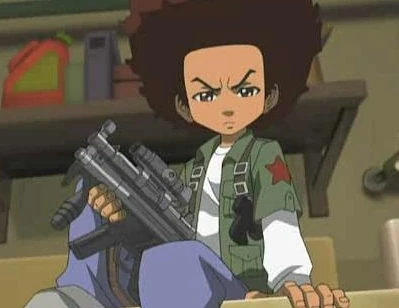
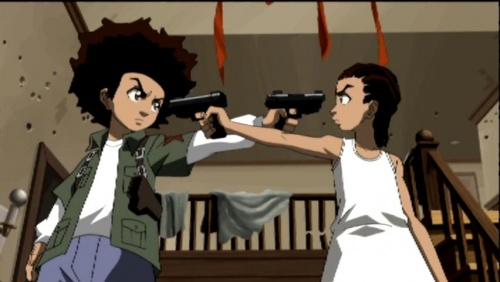
What makes The Boondocks such a stand-out strip are the characters that McGruder presents. The main characters of the strip are Huey, Riley, and their grandfather Robert Freeman, often called Grandad. I believe Huey and Riley may be based loosely upon Aaron McGruder himself and his brother Dedric respectively, although McGruder denies Huey to be his alter ego (Kang, “Down”). Much like the McGruder brothers, Huey and Riley are removed from the comfort of their black neighborhood in Chicago to a white neighborhood. They then struggle to adapt to their new surroundings in Woodcrest.
Having come from black schools all my life to a primarily Caucasian university, I find myself with a sense of displacement at times. I struggle as those around me don’t fully understand the workings of the world as I do. They don’t see the same undertones in the media or in day-to-day conversation. I can only laugh quietly to myself whenever a joke that would have flown freely in high school pops into my head while in my Theology class. Were it not for the few other black students on campus, I might find myself completely at the mercy of the white culture around me.
Of all the characters in the Boondocks universe, I connect with Huey the most. We both see the world through constant critique, never truly satisfied with its current state. He is as much of a radical and free thinker as the man he is named after, Black Panther co-founder Huey P. Newton. Freeman is also a play on the term freedman, used to describe a freed slave. However, Huey does not necessarily feel free; he believes his people still have a long way to go before they can truly advance as a race. He wants all his black brothers and sisters to succeed, just as I do. We both are looking out for the best interest of black people, even if means disagreeing with the choices our people make. He believes the government is to blame for many failures in America; conspiracy theories are his forte. He’s very preachy and rarely smiles. In one strip, Huey reads the newspaper, as he is a well-read individual. He sees his horoscope, which happens to be highly specific this day: “You will continue to fervently hope Al Sharpton cuts his hair so that he may be taken more seriously by the masses – the irony of which will escape you” (“All the Rage”, 17). Huey plays ignorant to the message, but the irony is that he too sports an afro and is often disregarded by those around him. Sometimes people just don’t understand the message you want to give them.
Huey and Riley represent the two extremes of the black community. While Huey is the revolutionary, angry black kid you can’t stand to hear, Riley’s character is almost so ignorant and stereotypical that you have to love him. He’s also a believable character because I have actually met people like him. He is obsessed with the street life and will do whatever he needs to remain true to his culture in the midst of suburbia. He often puts down Huey or completely ignores him. He is the kind of black person I love to hate, because they are the type most likely to embarrass the whole race and typically look for the easy way out. For instance, when Riley learns about presidential pardons, he thinks it’s his chance to get away with anything he wants. He even sits down to write a letter to ex-President Clinton to set up a relation until Huey interrupts to inform that only the current president can grant pardons. Riley then exclaims, “Great!!! Well, this is the last time I make an effort to participate in government!!!” (“A Right…”, 112). Stereotypical black people, like Riley, are only concerned with learning or helping when it directly benefits them. McGruder, Huey, and I all share a deep distaste for such acts of ignorance and selfishness.
While the Freeman brothers are near polar opposites, their grandfather Robert Jebediah “Grandad” Freeman is a balance between righteousness and ignorance. Since moving the boys out to Woodcrest, he’s tried to provide as best he can for them, though he doesn’t always understand them. During a short succession of strips, Grandad attempts to connect with Riley through the use of rap songs. Riley can’t help but sigh as Grandad says such things as, “…Then there’s that T.I. boy runnin’ ‘round talking about ‘You don’t know me.’ But do any of us really know each other? …. And that’s all Bill Cosby is saying” (“All the Rage”, 79). On a separate occasion, he takes the boys shopping and offers to buy Riley three pairs of Air Force Threes because they’re 80% off when his grandson says he’ll only wear Air Force Ones, a popular expensive sneaker at the time. While he is helpful, Grandad is often selfish and self-centered as well. He’s very protective of his orange juice; it is a full day’s worth of vitamin C after all. Then when his cousins left homeless by Hurricane Katrina come to seek refuge, he pretends to not be home even with his cousins at his doorstep. Grandad is truly diverse in character.
As with any brutally honest cartoon, show, or program, The Boondocks received its share of criticism. One beef McGruder held was with BET (Black Entertainment Television). He had always disagreed with the way they represented the black race with degrading music videos and other generally bad programming; he also disagreed with their overall monopoly on the black television demographic (Henderson, “A.M. Biography”). In one strip, McGruder pointed out that BET founder Bob Johnson said his network “does more to serve the Black community” than McGruder does. McGruder then shows a signal panel of a black behind shaking vibrantly “in order to follow the fine example set by Mr. Johnson” (“A Right…”, 50). One a separate occasion, McGruder touches on the BET buyout made by Viacom and has Huey call Viacom directly and request them to fire Bob Johnson so that BET can begin to head in a new direction, towards more positive programming (90). I, too, have felt that BET shames the race in the way the network depicts black people. With the recent addition of certain reality shows, BET is worse than ever. Before, I would turn the channel from a show I was poking fun at whenever a white roommate walked into the living room, not wanting to perpetuate any of the stereotypes the programming might contain. Now I’ve stopped watching BET completely, at least until it gets its act together.
Perhaps the biggest controversy The Boondocks comic strip faced was shortly after 9/11. When everyone else shied away from placing blame on anyone or criticizing the president, McGruder held no punches. On the actual date, he was busy on one of his usual tirades, this time against actress Vivica A. Fox. Two weeks later, the strips McGruder wrote to address the issue ran in the papers. For this portion of the strip’s run, Huey and his friend Caesar, the only other black kid in the neighborhood, watch the news coverage. Most of the coverage makes fun of itself, but Huey will interject his opinion as well when necessary. Later in the year around Thanksgiving, Huey is asked to pray over the meal: “In this time of war against Osama bin Laden and the oppressive Taliban Regime… we are thankful that our leader isn’t the spoiled son of a powerful politician from a wealthy oil family… and uses war to deny people their civil liberties. Amen” (175). In response to critics asking about the comparison of President Bush to bin Laden, McGruder pointed out that he never explicitly mentioned Bush’s name in that particular strip. He went on to say, “If the reader reads what I wrote and thinks about G. W. Bush, that means it’s f****** true!” (Lemons, “Creator”). McGruder goes on to say that readers shouldn’t be mad at him for drawing connections they made themselves.
Just as McGruder did, Huey and I both started our own sort of publications. I have The Wacko Monologues, a blog that I use to voice my own opinion on topics from race, sexuality, double standards, and taboos as well as other various topics. I like to pride myself on the tagline “Insight and Humor” for they are the best duo of all time. I also try to omit names as often as possible when I recount personal events, much like when McGruder alludes to certain public figures in his strips. Huey has his Free Huey Report which he uses as a vehicle to criticize the government, pop culture, and anything else he sees fit. In the comic strip, it is joked that he only has 12 readers, more than half of which only read it to disagree with him. When he has his neighbor, Attorney Thomas Debois, read his issue, it is believed that Huey takes “too many liberties with the facts to call [it] a newspaper” (“A Right…”, 70). When asked why, Thomas responds, “Well, how do you know G.W. Bush smoked crack?” (70). Huey simply argues if it was that unbelievable that Bush could have ever smoked (70). This type of social commentary is what McGruder needed to be shed in the comic section of the paper, Because I Know You Don’t Read the Newspaper according to the title of his first collection of the Boondocks strips.
As mentioned before, The Boondocks is also a television program. The comic strip has since been cancelled, as to make things easier on McGruder. The series has come under the same criticism as its still counterpart, but the two mediums have their differences. The most notable difference is the lack of strong stances on politics. McGruder attributes this to two factors: the nine month delay between the writing and animating process and deciding to ease up a bit (Braxton, “He’s Gotta…”). Because McGruder decided to go with an anime style for The Boondocks, the show is sent to Japan to be drawn (“He’s Gotta…”). Such a lapse of time makes it impossible to be topical on a regular basis. Another notable difference is the reduced focus on Huey as the story follows Riley, Grandad, and even other supporting characters in their neighborhood. Huey always narrates the story, however, for he holds the insight. This is how the story remains his as he interjects his own views and opinions on the actions of others.
If The Boondocks has taught me nothing else, seeing race is beneficial. It has allowed me to view the whole picture. I can be sensitive to different issues and know when others are offending me or passing judgments they may not even realize they are passing. This is why I value Aaron McGruder and Huey Freeman as much as I do: because they are lights of knowledge in the darkness that has become our ignorant society.

March 22, 2012

On Looking Suspicious

There just seems to be all kinds of f**kery occurring in March.
By now, we've all heard about the death of Trayvon Martin
and the possibly most likely racist self appointed head of the neighborhood watch who shot him.
Here's an article if you haven't.

Through the years, there have been far too many instances of a black person, more specifically a black male, looking suspicious enough to justify a beating or murder with a very slow legal process following, if any at all.
It's enough to terrify a young black man.
Certainly enough to scare me.

As usual, I avoided looking into the situation
because I knew it would only infuriate me and I like having pleasant days.
But these sort of things always find their way to me.
Today in my writing seminar,
we talked about the massacre of 16 Afghans -
which is another very important issue and discussion.
Of course, a relation was made to Trayvon and we talked about it.
Midway through the conversation, the topics racial profiling and suspicion arose.

I avoided adding my two cents in the conversation,
being the only kid of color in the room,
forcing me to have an internal dialogue.
I realized what I was wearing: a red and black plaid lightweight hoodie,
black shorts, red Chuck Taylors, and an ironically outdated red fitted cap I found.
I realized where I was: a extremely white campus where topics of race and discrimination are avoided by the majority.
I realized the person I was molding myself into: a self-proclaimed black hipster who knew how to interact with Caucasians and educated black folk, while gained the trust and respect of said individuals.
It was at this moment I became aware of what I was doing: becoming as far from "suspicious" as possible.

It's hard to pinpoint if I actively set out
to accomplish this as a high school graduate
and consciously forgot my mission along the way,
but I wouldn't put it pass myself.

Still to the best of my abilities,
I can't escape the feelings that I don't belong.
Whenever I walk through a predominantly white neighborhood,
I still feel the need to tread lightly.
I utterly refuse to run through such neighborhood.
Actually, I wouldn't run pass a cop car either.
No need to give them any reason to berate me.

In light of the 9/11 attacks,
you would think white would target middle easterners instead.
In fact, I remember jokes around black neighborhoods
wishing such would actually happen.
The reality of the situation is that
the terrorists are not on our soil but overseas.
Whereas African-American hoodlums are a prominent issue here.

Am I saying stereotyping as such is acceptable? No.
Do I propose anything to fix this issue? Yes,
but such a theory deserves sharing with other and feedback before becoming public.
What I will say is this.
To this day in the 21st century,
I am still cautious about being a black man in America.
I do not deserve such a terror to haunt me.
Yet I fear it may loom forever over us.
Word.

March 19, 2012

Story Time: They Called Me Nigger

I remember looking out the window of my mom’s car on the way to school at miles of trees and farm land. The South was so different from New York City. I wouldn’t find a crowded subway anywhere near here. After twenty minutes, we arrived at St. James Prep, a private all-male Catholic school. My mom always preferred private schools to public: better education and morals, she said. I left the car without saying goodbye, my mind too focused on the day before me.
            The brick porch leading to the entrance was bare; we must have misjudged the starting time. Late for my first day of high school, what a way to start the school year, I thought. Entering the building, I searched my pockets for my class schedule. I walked through the empty halls until I found my homeroom, cracking open the door and poking my head in.
            “Ah, you must be Mr. Williams,” the teacher motioned towards me. “Please, have a seat.”
            As I took my seat in the front, the only spot left, I looked at my fellow classmates. There were only three other kids the same color as me. My middle school had been much more diverse. I wondered if this was how the population of the entire school broke down. I snapped out of my thoughts as the teacher introduced herself and told us that high school would be much harder than middle school.  We were let out at the bell’s ring. I didn’t bother looking for my locker just yet since I had nothing to put in it. Besides, I felt stares from other students while walking in the hall. Was it that obvious that I was a city boy?
            The same was true for my following three classes. In Algebra, there were two the same race as me; in U.S. History, there were four of us; in English, I was on my own. It wasn’t until lunch that I saw more than ten of us at a time. My people were all sitting together at a table in the corner. I was tempted to join them, but I refused to segregate myself. As I expected, the other tables were completely made up of the majority. I tried to put my anxiety aside as I walked over to a table in the middle of the cafeteria.
            “Hi,” I said as I placed my tray down. “My name is Taylor.”
            I was greeted warmly by a boy directly across from me. “Nigga, why don’t you just sit with da rest of da crackas in da corner? You know you want to.”
            I froze upon hearing “the word.” I had never heard it much at my old school. Maybe once or twice while walking around the city but never in school. I couldn’t believe he had called me one. I thought that was something black people reserved for themselves. “You’re talking to me?” I asked.
            “Yeah you, nigga. You see anyone else without pigment in their skin at dis table?”
            “N-no.”
            “Then get ya ass to da table in da corner, then!”
            I walked in shame to the table in the corner. I wasn’t aware that integration was a crime in the South. I took my place at the White table in silence.
            “Don’t let him get to you. I hear it’s like this with every freshman class. They’ll warm up to us as the school year goes on,” a red-haired kid explained. “My name is Rufus, but you can just call me Ruff.”
            “…Are you trying to make your name sound less white?”
            “If you want to put it so bluntly, yes. I’m attempting not to get picked on for my name. Do you know how corny and white Rufus sounds?”
            “I’m Lenny,” the kid next to me interjected. “You know, I heard that once we get to be seniors, we’ll gain enough respect from the black kids to actually start using the word ourselves.”
            “You must have heard a lie,” I told him. “No self-respecting black person would let you call him the N-Word.”
            “No, it’s true.” Ruff agreed. “My older brother graduated from here last year. He said it starts with us making fun of the black stereotypes anytime they joke about a white stereotype. Then we begin to call ourselves the word, first while no blacks are around so we can get use to hearing and saying it without cringing. Finally, our senior year, one of us has to be brave enough to try it out on one of them. Someone in the middle, no one too popular or unpopular. Once that’s done, we can come together as a whole class and use the word as a term of endearment.”
            “Oh, so the kid at the table called me the word as a term of endearment?”
            “No, he was disrespecting you,” Lenny clarified. “Blacks use it both ways. We can only use it in its positive sense.”
            “Right, using it negatively like they do will only end in a fight,” added Ruff.
            “God, I thought remembering math equations would be hard.”
            “Well, it’s kinda like math,” Lenny said. “The things you learn one day will be implemented for the entirety of your stay here at St. James. “
            “Oh, that reminds me,” Ruff leaned in close and stared right into my eyes. “Don’t use big words around some of them. They’ll think you’re trying to embarrass them.”
           
            I sat down at the table and peered directly into the eyes of the kid who told me to leave the table prior. “What do you want now?”
            “I want to be accepted for who I am, not the color of my skin” I paused for dramatic effect, realizing how lame and cliché I must have sounded. Then I finished, “nigger.” They called me the word, so why couldn’t I call them the same?  However, it took every fiber in my body to keep me from running out of the cafeteria.
            I should have ran, because just as the word left my mouth, the two kids sitting next to me grabbed my arms as the other lunged across the table. I don’t think I had ever been beaten so badly in my life. It was two minutes before anyone tried to break it up. The black teacher supervising the lunch wanted me to learn my lesson. I thought about telling the principal about his lack of intervention, but I didn’t want to get in bad with the faculty too.
            Apparently, I had stopped listening to Ruff and Lenny just as they were explaining the difference between the –a and –er forms of the word. It made a world of a difference, I realized now. Damn my proper grammar. As I laid in the nurse’s room, waiting for my mother to come in, ice on my right eye, I doubted that even if I had used the –a version of the word I would have broke down the racial barrier in the school. I would have to approach the issue with more subtlety next time. Maybe I could joke how the black kids had made me black and blue, that I was one of them now. I think I’ll wait until this whole mess blows over though. Enough insult and injury had been exchanged to last the week.