
There was a time when I didn’t see color. It was beautiful. Those days in Newark, NJ during grammar and middle school seem so simple in comparison now. My best friend for the majority of those years was a Puerto Rican. He was one of the few non-black students in my school, but I welcomed him with open arms as my mother had taught me. It was only after I transferred during my 5
th grade year that I discovered that my friend actually held roots from Portugal. I had mistaken the Portuguese spoken in his home for Spanish.
Even still, I remained ignorant of race through my career at an almost entirely black middle school. It was not until high school that I began to see racial divides and tensions. Though the population was still predominantly black, there were decent amounts of whites, Hispanics, and Asian students. Before, the distraction of girls helped push racial issues to the side. In high school, there were no girls. This factor allowed the gloves to come off. Slurs and jokes, ranging from race and social status to gender and sexuality, were thrown around freely even in the classroom.
The cafeteria was the perfect place to have free flowing discussions and to review popular culture and televisions shows. During the earlier years of high school, Chappelle’s Show was championed as the best show on television for its brutally honest jokes and sketches. It was popular because it delivered harshness with hilarity, the perfect prescription to a generation that hates to be lectured and wants instant gratification. I quickly began to admire Chappelle’s style. When his show ended on Comedy Central in 2004, a void appeared. It was an abyss created by the lack of a black voice exposing the problems in today’s society. In 2005, the space was filled by a new show on Cartoon Network’s Adult Swim lineup called The Boondocks. It became the new voice of the young black generation and my new inspiration.
I laughed uncontrollably at the world Aaron McGruder had created while appreciating the message that was almost hidden in each episode. It wasn’t until the show’s first season ended that I became aware that the show was based on the comic strip by the same name. I felt obligated, as a young black man who deeply wanted to find a voice to educate his peers, to immerse myself deeper into the world McGruder produced to bring his vision to light.

Having lived in a white neighborhood and gone to a white Jesuit elementary school in Columbia, MD, McGruder decided to attend a predominantly black high school (Henderson, “A.M. Biography”). He felt it necessary to connect more with his black community. After high school, he attended the University of Maryland to obtain “a degree in Afro-American studies” (“A.M. Biography”). According to Ashyia Henderson, McGruder’s
The Boondocks first premiered on the Hotlist Online website in 1996, after which it appeared in his college newspaper, The Diamondback, until there was dissention between the school and McGruder (“A.M. Biography”). Still determined to have his vision shared with those around him, he began submitting strips to the popular Hip-Hop magazine
The Source in 1997. Soon after, the Boondocks began running in newspapers around the country in 1998 after McGruder was contacted by Harriet Choice of the Universal Press Syndicate (“A.M. Biography”).
What makes The Boondocks such a stand-out strip are the characters that McGruder presents. The main characters of the strip are Huey, Riley, and their grandfather Robert Freeman, often called Grandad. I believe Huey and Riley may be based loosely upon Aaron McGruder himself and his brother Dedric respectively, although McGruder denies Huey to be his alter ego (Kang, “Down”). Much like the McGruder brothers, Huey and Riley are removed from the comfort of their black neighborhood in Chicago to a white neighborhood. They then struggle to adapt to their new surroundings in Woodcrest.
Having come from black schools all my life to a primarily Caucasian university, I find myself with a sense of displacement at times. I struggle as those around me don’t fully understand the workings of the world as I do. They don’t see the same undertones in the media or in day-to-day conversation. I can only laugh quietly to myself whenever a joke that would have flown freely in high school pops into my head while in my Theology class. Were it not for the few other black students on campus, I might find myself completely at the mercy of the white culture around me.
Of all the characters in the Boondocks universe, I connect with Huey the most. We both see the world through constant critique, never truly satisfied with its current state. He is as much of a radical and free thinker as the man he is named after, Black Panther co-founder Huey P. Newton. Freeman is also a play on the term freedman, used to describe a freed slave. However, Huey does not necessarily feel free; he believes his people still have a long way to go before they can truly advance as a race. He wants all his black brothers and sisters to succeed, just as I do. We both are looking out for the best interest of black people, even if means disagreeing with the choices our people make. He believes the government is to blame for many failures in America; conspiracy theories are his forte. He’s very preachy and rarely smiles. In one strip, Huey reads the newspaper, as he is a well-read individual. He sees his horoscope, which happens to be highly specific this day: “You will continue to fervently hope Al Sharpton cuts his hair so that he may be taken more seriously by the masses – the irony of which will escape you” (“All the Rage”, 17). Huey plays ignorant to the message, but the irony is that he too sports an afro and is often disregarded by those around him. Sometimes people just don’t understand the message you want to give them.
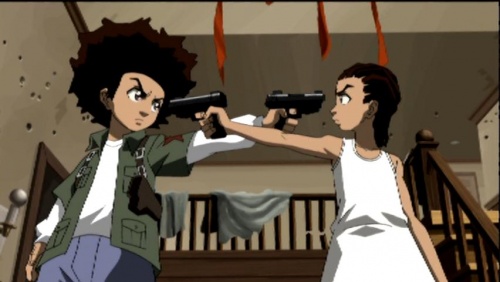
Huey and Riley represent the two extremes of the black community. While Huey is the revolutionary, angry black kid you can’t stand to hear, Riley’s character is almost so ignorant and stereotypical that you have to love him. He’s also a believable character because I have actually met people like him. He is obsessed with the street life and will do whatever he needs to remain true to his culture in the midst of suburbia. He often puts down Huey or completely ignores him. He is the kind of black person I love to hate, because they are the type most likely to embarrass the whole race and typically look for the easy way out. For instance, when Riley learns about presidential pardons, he thinks it’s his chance to get away with anything he wants. He even sits down to write a letter to ex-President Clinton to set up a relation until Huey interrupts to inform that only the current president can grant pardons. Riley then exclaims, “Great!!! Well, this is the last time I make an effort to participate in government!!!” (“A Right…”, 112). Stereotypical black people, like Riley, are only concerned with learning or helping when it directly benefits them. McGruder, Huey, and I all share a deep distaste for such acts of ignorance and selfishness.
While the Freeman brothers are near polar opposites, their grandfather Robert Jebediah “Grandad” Freeman is a balance between righteousness and ignorance. Since moving the boys out to Woodcrest, he’s tried to provide as best he can for them, though he doesn’t always understand them. During a short succession of strips, Grandad attempts to connect with Riley through the use of rap songs. Riley can’t help but sigh as Grandad says such things as, “…Then there’s that T.I. boy runnin’ ‘round talking about ‘You don’t know me.’ But do any of us really know each other? …. And that’s all Bill Cosby is saying” (“All the Rage”, 79). On a separate occasion, he takes the boys shopping and offers to buy Riley three pairs of Air Force Threes because they’re 80% off when his grandson says he’ll only wear Air Force Ones, a popular expensive sneaker at the time. While he is helpful, Grandad is often selfish and self-centered as well. He’s very protective of his orange juice; it is a full day’s worth of vitamin C after all. Then when his cousins left homeless by Hurricane Katrina come to seek refuge, he pretends to not be home even with his cousins at his doorstep. Grandad is truly diverse in character.
As with any brutally honest cartoon, show, or program, The Boondocks received its share of criticism. One beef McGruder held was with BET (Black Entertainment Television). He had always disagreed with the way they represented the black race with degrading music videos and other generally bad programming; he also disagreed with their overall monopoly on the black television demographic (Henderson, “A.M. Biography”). In one strip, McGruder pointed out that BET founder Bob Johnson said his network “does more to serve the Black community” than McGruder does. McGruder then shows a signal panel of a black behind shaking vibrantly “in order to follow the fine example set by Mr. Johnson” (“A Right…”, 50). One a separate occasion, McGruder touches on the BET buyout made by Viacom and has Huey call Viacom directly and request them to fire Bob Johnson so that BET can begin to head in a new direction, towards more positive programming (90). I, too, have felt that BET shames the race in the way the network depicts black people. With the recent addition of certain reality shows, BET is worse than ever. Before, I would turn the channel from a show I was poking fun at whenever a white roommate walked into the living room, not wanting to perpetuate any of the stereotypes the programming might contain. Now I’ve stopped watching BET completely, at least until it gets its act together.
Perhaps the biggest controversy The Boondocks comic strip faced was shortly after 9/11. When everyone else shied away from placing blame on anyone or criticizing the president, McGruder held no punches. On the actual date, he was busy on one of his usual tirades, this time against actress Vivica A. Fox. Two weeks later, the strips McGruder wrote to address the issue ran in the papers. For this portion of the strip’s run, Huey and his friend Caesar, the only other black kid in the neighborhood, watch the news coverage. Most of the coverage makes fun of itself, but Huey will interject his opinion as well when necessary. Later in the year around Thanksgiving, Huey is asked to pray over the meal: “In this time of war against Osama bin Laden and the oppressive Taliban Regime… we are thankful that our leader isn’t the spoiled son of a powerful politician from a wealthy oil family… and uses war to deny people their civil liberties. Amen” (175). In response to critics asking about the comparison of President Bush to bin Laden, McGruder pointed out that he never explicitly mentioned Bush’s name in that particular strip. He went on to say, “If the reader reads what I wrote and thinks about G. W. Bush, that means it’s f****** true!” (Lemons, “Creator”). McGruder goes on to say that readers shouldn’t be mad at him for drawing connections they made themselves.

Just as McGruder did, Huey and I both started our own sort of publications. I have The Wacko Monologues, a blog that I use to voice my own opinion on topics from race, sexuality, double standards, and taboos as well as other various topics. I like to pride myself on the tagline “Insight and Humor” for they are the best duo of all time. I also try to omit names as often as possible when I recount personal events, much like when McGruder alludes to certain public figures in his strips. Huey has his Free Huey Report which he uses as a vehicle to criticize the government, pop culture, and anything else he sees fit. In the comic strip, it is joked that he only has 12 readers, more than half of which only read it to disagree with him. When he has his neighbor, Attorney Thomas Debois, read his issue, it is believed that Huey takes “too many liberties with the facts to call [it] a newspaper” (“A Right…”, 70). When asked why, Thomas responds, “Well, how do you know G.W. Bush smoked crack?” (70). Huey simply argues if it was that unbelievable that Bush could have ever smoked (70). This type of social commentary is what McGruder needed to be shed in the comic section of the paper, Because I Know You Don’t Read the Newspaper according to the title of his first collection of the Boondocks strips.
As mentioned before, The Boondocks is also a television program. The comic strip has since been cancelled, as to make things easier on McGruder. The series has come under the same criticism as its still counterpart, but the two mediums have their differences. The most notable difference is the lack of strong stances on politics. McGruder attributes this to two factors: the nine month delay between the writing and animating process and deciding to ease up a bit (Braxton, “He’s Gotta…”). Because McGruder decided to go with an anime style for The Boondocks, the show is sent to Japan to be drawn (“He’s Gotta…”). Such a lapse of time makes it impossible to be topical on a regular basis. Another notable difference is the reduced focus on Huey as the story follows Riley, Grandad, and even other supporting characters in their neighborhood. Huey always narrates the story, however, for he holds the insight. This is how the story remains his as he interjects his own views and opinions on the actions of others.
If The Boondocks has taught me nothing else, seeing race is beneficial. It has allowed me to view the whole picture. I can be sensitive to different issues and know when others are offending me or passing judgments they may not even realize they are passing. This is why I value Aaron McGruder and Huey Freeman as much as I do: because they are lights of knowledge in the darkness that has become our ignorant society.


